
 Shop
ShopThe Coldcard Q is a bitcoin-only hardware wallet. It generates and stores your private keys offline, without connecting to the internet. Sending and receiving bitcoin transactions using your Coldcard device using Sparrow Wallet as your coordinator is covered in Coldcard and Sparrow Wallet Setup.
This guide covers the initial setup of a Coldcard Q: receiving and inspecting the device, learning the layout and keys, setting a PIN, generating a seed phrase, and completing the backup verification quiz. When you are done, you will have a fully initialized device with a confirmed backup, ready to transact with bitcoin.
Before you begin
Before getting started, you will need to have bought and received a Coldcard Q. You can purchase directly from Coinkite at coinkite.com or from an approved reseller.
To proceed with setup, have the following with you:
- Coldcard Q in its factory-sealed tamper-evident bag.
- Power source. 3x AAA batteries are recommended for a fully air-gapped setup. Batteries are not included in the box and must be sourced separately. A standard USB-C cable and power source also works.
- A pen. A paper backup card is included in the box for writing down your PIN, anti-phishing words, and seed phrase. For a more durable backup for your seed phrase, you can record it on a metal plate.
- MicroSD card. This is not required for initial device setup, however, it is recommended to have at least one MicroSD card available as an added signing method and for firmware updates. MicroSD cards must be FAT32 or FAT12 formatted and be 512 MB to 32 GB. MicroSD cards are available for purchase, along with additional device accessories.
Get to know your Coldcard Q
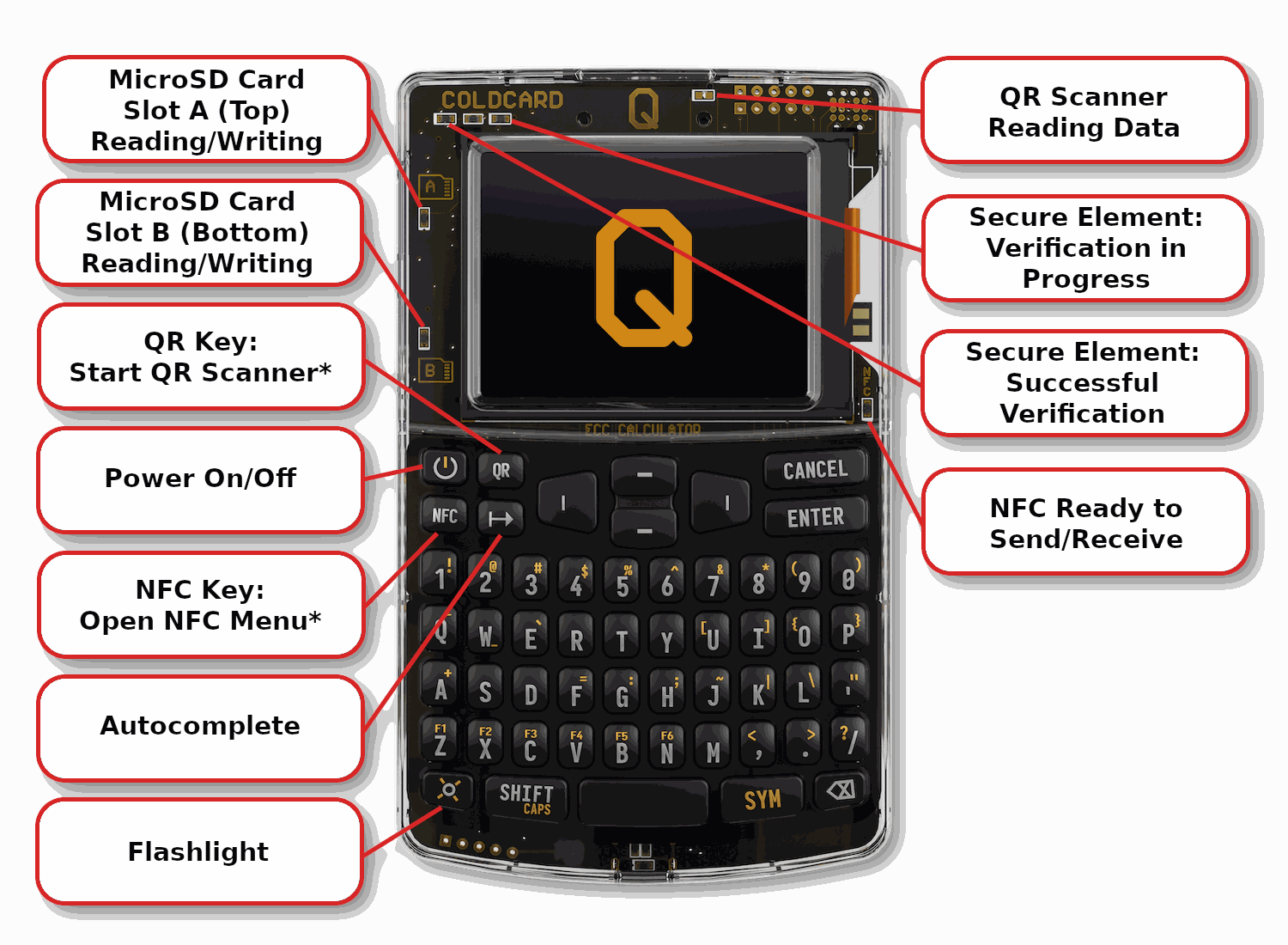
Before starting the setup steps, spend a minute getting familiar with the Q's layout. The Q is not a touchscreen. All navigation is done via the keyboard and dedicated keys.
Keys and navigation
The Q has a full QWERTY keyboard. During setup you will use it for:
- PIN entry: use the number row (1 through 0) to type PIN digits
- Menu selection: press the number shown next to a menu item to select it, press ENTER to confirm, press CANCEL or the escape key to go back
- Seed quiz: the device displays three word options for each position in your seed phrase. Press 1, 2, or 3 to select the correct word.
The navigation keys scroll up and down through screens with longer content, such as the Terms of Sale.
Screen and status LEDs
The Q has a large color LCD screen. Status LEDs in the top-left corner of the device indicate its state. During normal operation the LED should be green. If the LED is red at any point after entering your PIN, stop and investigate before proceeding.
Power options
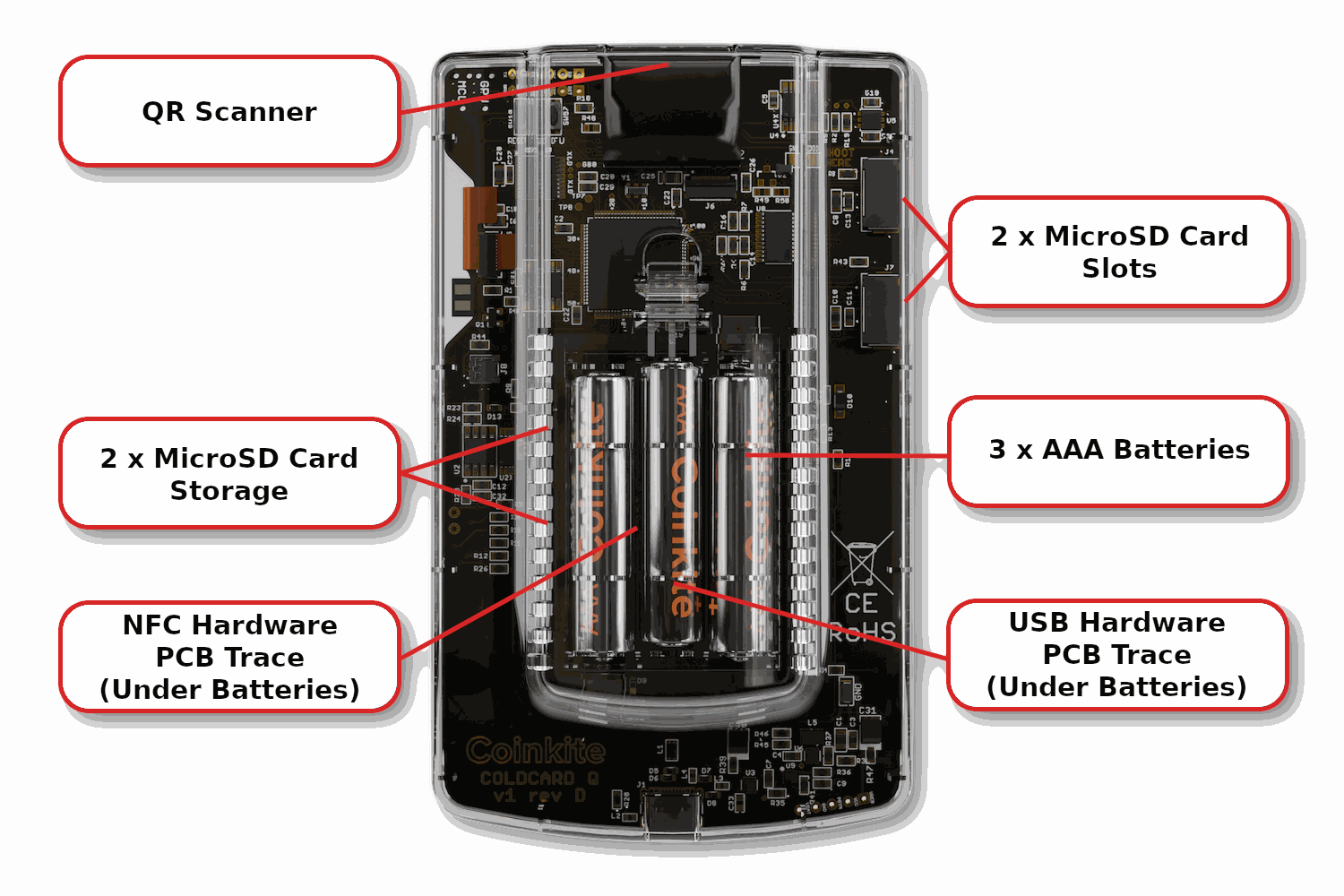
The Q can run on 3x AAA batteries installed under the battery door on the rear, or from any USB-C power source. Batteries are not included in the box and must be sourced separately. For initial setup, batteries are recommended so the device remains fully air-gapped with no physical connection to a computer.
-
Power on: Hold the power key for one full second. The screen activates and the Q shows the Terms of Sale on first boot.
-
Power off: Hold the power key for two seconds. This clears sensitive values from memory before shutting down. If for some reason the device is locked up or otherwise unresponsive, you can hold the power key for 10 seconds to power down regardless of the state of the firmware.
MicroSD card slots
The Q has two MicroSD card slots on the left side of the device, labelled A (top) and B (bottom). They use a push-pull mechanism, so you can easily press them in and pop them out. Insert the card with the gold contact points facing toward the screen. For initial setup, no MicroSD card is required.
QR Scanner
The QR scanner reads QR codes, BBQr codes, and standard barcodes. Its lens sits behind the screen and points toward the top of the device, with a red strobe light showing where it is aimed. If a code is hard to read, press the flashlight key to turn on the LED next to the lens.
To scan, press the QR key or select Scan Any QR Code from the Main Menu. Coldcard responds based on what the code contains. If it isn't a recognized Bitcoin format, it is simply displayed as text.
NFC Tap
The on-device NFC tool sits behind the screen, so tap your Coldcard within about 4cm of the other device once NFC is active. No precise orientation of the device is needed within that range.
PCB Traces
On the back of the Q, under the batteries, are two cutouts in the case exposing the PCB traces for the NFC and USB hardware. You can permanently disable the NFC and/or USB hardware by scratching off the copper foil in these spots. Please note that scratching off a PCB trace is irreversible.
Setting up your Coldcard Q
Upon receiving your Coldcard Q in its tamper-evident bag, follow the below step-by-step procedure to set it up.
-
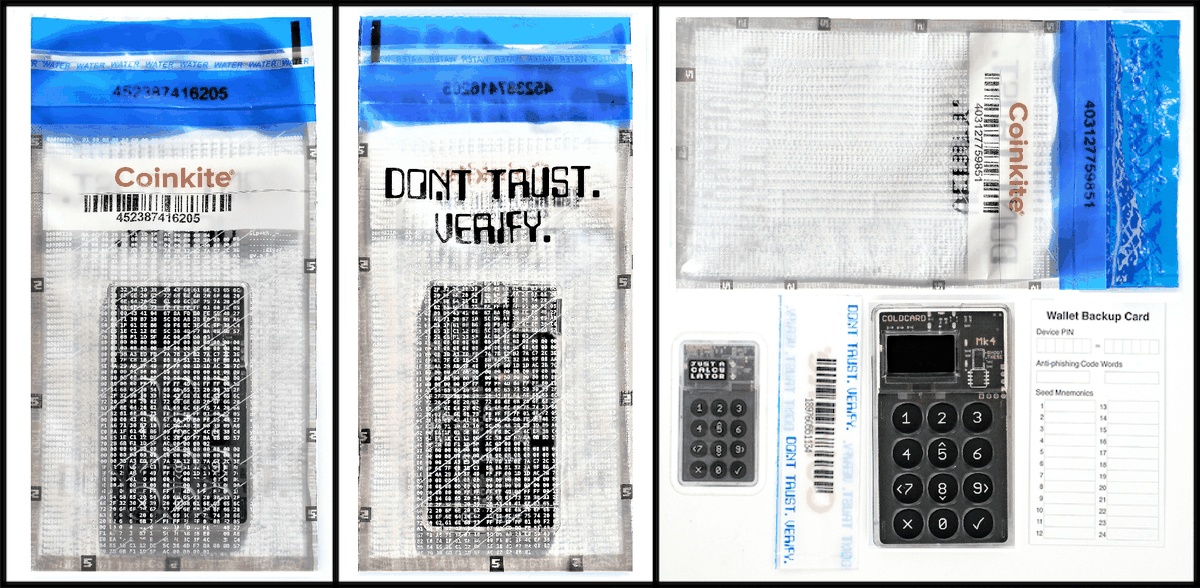
Inspect the tamper-evident bag. Examine the bag for signs of tampering: torn seals, re-sealed areas, or misaligned perforations along the edges. If everything looks fine, open the bag and you will find a tear-off tab printed with the device's serial number. Check that this number matches the serial number printed on the bag exterior.
If the bag appears compromised in any way, do not power on the device. Contact support@coinkite.com before proceeding.
-
Power on the Coldcard Q. Insert three AAA batteries into the battery compartment on the rear, or connect a USB-C cable to a power source. Then hold the power key (top-left corner of the keyboard) for one full second until the screen activates and the Q shows the Terms of Sale screen. The Q does not power on automatically when USB-C is connected. You must press and hold the power key.
-
Accept the Terms of Sale. Review the terms and use the navigation keys to scroll through the full text. Press ENTER at the bottom to accept.
-
Verify the serial number on screen. After accepting the Terms of Sale, the device displays the Coldcard's serial number on screen. Confirm this number matches the serial number on the bag exterior and the tear-off tab inside the bag. All three should be identical. Press any key to continue to the initial setup screen.
The device will show three options: Choose PIN Code, Advanced/Tools, and Bag Number. Select Choose PIN Code to proceed with device setup.
PIN Setup
After selecting "Choose PIN Code," you'll see two screens to read before you can enter your PIN. Scroll down and read through each one carefully before pressing ENTER.
How the PIN system works
The Coldcard PIN has two parts, separated by a dash, for example:
12-341234-5678872323-3984312-345678
The first part is the prefix and the second is the suffix. Each part can be 2 to 6 digits, so the combined length must be between 4 and 12 digits total. A "four plus four" PIN is recommended, such as 1234-5678. A "two plus two" PIN is allowed but more vulnerable to brute force attacks.
Anti-phishing words
Your PIN prefix determines a pair of anti-phishing words, unique to your specific device. No two Coldcards produce the same word pair for the same prefix.
Every time you log in, these words appear after you enter your prefix and before you enter your suffix. In the future, if you correctly enter your PIN prefix and the anti-phishing words that are displayed are not correct, stop and do not enter your suffix. Unfamiliar words mean the device may have been tampered with or swapped.
The words also change if you change your prefix PIN, so update your written record if you do.
Your PIN cannot be recovered
The second screen during setup warns that there is no way to recover a forgotten PIN. You must press the specific key shown on screen, not just ENTER, to confirm you have read the message. The device won't advance until you press the correct key. The secure element enforces a limited number of attempts with no reset mechanism, including no reset by Coinkite. If all attempts are exhausted, the device permanently bricks. Write your complete PIN in a secure location, separate from your seed phrase backup.
Setting your PIN
When ready to set your PIN, get your Wallet Backup Card, which is the piece of paper shipped with your Coldcard Q. You will use it to write down your PIN and anti-phishing words.
-
Enter your prefix PIN. Using the number row, type 2 to 6 digits as the first part of your PIN and press ENTER. The device will display your two anti-phishing words.
-
Record your anti-phishing words. Write both words on the paper card now, along with your prefix digits. The Q moves directly to suffix entry after showing these words.
-
Enter your suffix PIN. Type 2 to 6 more digits as the second part of your PIN and press ENTER. Record your suffix digits on your card.
-
Confirm your full PIN. The device runs through the full sequence again to check for entry mistakes. Re-enter your prefix PIN and press ENTER. The anti-phishing words appear again, so verify they match your written record. The Q then moves directly to suffix entry. Re-enter your suffix PIN and press ENTER. If both parts match, the PIN is saved to the secure element and the device advances to the main menu in a blank wallet state. No seed has been generated yet.
If the anti-phishing words look wrong during confirmation, press CANCEL, as you likely mistyped the prefix. If you get repeated mismatches, press CANCEL twice to return to the main menu and restart PIN setup from the beginning.
Seed Phrase
Update required before wallet setup: Firmware updates require a PIN. After inspecting the bag and setting your PIN, stop at the main menu before choosing a seed or restore option. Check the current security status, install the current recommended Q standard firmware, and follow the signed firmware verification and upgrade instructions. Do not select New Seed Words or Import Existing, restore a backup, or fund the wallet until the installed version is confirmed. Updating firmware does not change an existing affected seed. If an existing seed was created on affected firmware, follow the migration guide.
After setting your PIN, the main menu shows four options: New Seed Words, Import Existing, Advanced/Tools, and Settings. For a new wallet, select New Seed Words and press ENTER.
Choosing your seed length and required user entropy
After selecting New Seed Words, choose 12 Words or 24 Words. Current standard firmware then requires one user-entropy method before it will generate the final seed:
- Mash Keys: Press at least 65 keys with unpredictable timing. Timing between presses is credited; key identity is mixed in but not counted, so repeating one key is valid. Do not enter a PIN or words.
- Dice Rolls: Roll a physical six-sided die again before every entry and provide at least 50 fair rolls. Do not invent a sequence or use an app.
- Coin Flips: Flip a physical coin again before every entry and provide at least 128 results, using
1for heads and0for tails.
The standard workflow combines the chosen input with fresh device entropy from its generator and both secure elements. Keep every input private and unrecorded. Obvious dice or coin distribution failures are rejected; this check does not prove randomness.
Firmware 1.5.2Q also offers View TRNG Words before the mix. The public verify_seed_mix.py tool can check dice-roll or coin-flip mixing offline; it does not support Mash Keys. Use a disposable run to check the math, then start again with new TRNG words and fresh, unrecorded input for the wallet you will fund.
Dice Rolls Only remains a separate advanced workflow under Advanced/Tools. It uses only the roll sequence and requires at least 50 rolls for 12 words or 99 for 24 words. Its on-screen hash is secret. Follow the Dice Rolls Only verification procedure only on a trusted offline device and erase every trace afterward. See the complete seed-generation instructions and entropy documentation.
A 12-word BIP-39 seed encodes 128 bits of entropy, while a 24-word seed encodes 256 bits. Both lengths are supported; choose the length that fits your backup process and threat model.
What to never do with your seed phrase
Your seed phrase is the master backup for your wallet. Anyone who sees it, photographs it, or otherwise gains access to it can recreate your wallet and spend all the bitcoin in it.
Never photograph or screenshot your seed phrase. Never type it into a phone, computer, or any app. Never email, message, or store it in any digital form, including cloud storage or password managers. Never share it with anyone, including someone claiming to be Coldcard or Coinkite support.
Write it only on paper or another physical medium, such as metal, and store it somewhere only you can access.
To learn more, see What Is a Seed Phrase? for an explanation of how your seed phrase relates to your private keys, and How to Store Your Seed Phrase for backup options and storage best practices.
Recording Your Seed Phrase
After selecting your seed phrase length, you will be shown your randomly generated seed phrase for you to record.
-
Write down all seed words in order. Write them down on your Backup Wallet Card , numbered from 1 to 12 (or 1 to 24), in clear and legible handwriting. Take your time, and double check the spelling of each word.
You can scroll to view the final seed phrase as a QR code, if you prefer to record it in that format. Press ENTER only after you have recorded the final words from your chosen seed-generation workflow.
-
Complete the seed quiz. The device will show each word position in random order, with three word choices. Press the number of the option that matches your written backup. You must complete every position correctly to proceed.
-
Create a metal backup (optional). For added durability against fire, water, and physical damage, transfer your seed words onto a metal backup plate, available from coinkite.com or other third party manufacturers.
This completes initialization. A final welcome screen confirms your wallet is set up, with USB, NFC, and Virtual Disk all disabled by default. You can enable any of these later in Settings.
Press ENTER to reach the main menu, where you'll see Ready To Sign, Address Explorer, Advanced/Tools, and Settings. This confirms the device is initialized and operational.
Before storing your Coldcard, perform a full power cycle to confirm your PIN works as expected. Hold the power key for two seconds to turn off the device, then hold it for one second to turn it back on. Enter your prefix PIN and check that the anti-phishing words match your written record. Then enter your suffix PIN and confirm the device returns to the main menu. This verifies your PIN is recorded correctly and your anti-phishing words are accurate before you rely on them.
Troubleshooting
| Symptom | Likely cause | Resolution |
|---|---|---|
| Device does not power on when USB-C is connected | Q requires manual power-on and does not auto-start from USB-C | Hold the power key in the top-left corner for one full second; wait for screen activation |
| Anti-phishing words look unfamiliar at a later login | Prefix PIN entered incorrectly, or device has been swapped | Re-enter the prefix carefully; if words still do not match your record, do not enter the suffix and contact support@coinkite.com |
| Seed quiz fails repeatedly | Transcription error in written backup | Re-read each written word carefully before the next attempt; check for visually similar BIP-39 words such as "caught" vs. "cause" |
| Device shows Login Countdown after PIN failures | Multiple incorrect PIN attempts triggered a delay timer | Wait for the countdown to complete before trying again; do not power off during the countdown |
| Main menu does not appear after quiz passes | Unexpected screen state | Power off and power back on using the power key; enter your full PIN; if the issue persists, check the current security status and firmware instructions |
Passphrase and Multisig
For any wallet intended to hold an amount whose loss would be materially harmful to you, use a strong, unique BIP-39 passphrase after the seed backup is verified. “Meaningful” is personal, not a fixed bitcoin or fiat threshold. A passphrase creates a separate wallet from the base seed wallet. Do not use a short, common, patterned, quoted, or reused passphrase. Back it up exactly and separately from the seed words, record that wallet's fingerprint, power-cycle the COLDCARD, re-enter the passphrase, and confirm the same fingerprint before depositing funds. A lost or mistyped passphrase opens a different wallet and cannot be recovered. Reserve the base wallet without a passphrase for setup, testing, or a deliberately limited balance.
A passphrase adds a barrier; it does not repair an existing seed generated on affected firmware and does not replace the migration guide. Follow the BIP-39 passphrase instructions and test the complete recovery process before relying on it.
For advanced setups, multisig can add another independent layer, but it also adds policy, backup, and recovery duties. Use it only after testing recovery for the complete wallet policy.
What to do next
Your Coldcard Q is initialized, your seed phrase is written down and verified, and your PIN is confirmed as working. The next step is connecting the Q to a coordinator software, such as Sparrow Wallet. Sparrow can track your wallet balance and prepare transactions for the Q to sign, all without the Q ever connecting to the internet.
Next guide: Coldcard and Sparrow Wallet Setup covers exporting your wallet descriptor from the Q and setting up a watch-only wallet in Sparrow.
Seed phrase information: How to Store Your Seed Phrase for backup options and storage best practices.
Further reading: What is air-gapped signing? explains the signing workflow the Q is now ready to perform.
Related guides
Set Up Your Coldcard Mk5
The Mk5 equivalent with the same setup milestones, adapted for the 12-key numeric keypad.
Coldcard and Sparrow Wallet Setup
Connect your initialized Q to Sparrow Wallet as a watch-only wallet.
What is Air-Gapped Signing?
The signing workflow your Q is now ready to perform. No cable required.
QR Code Air-Gapped Signing with Coldcard
A desktop-friendly signing channel using your screen and webcam.