Signing Device Comparison

Coldcard vs. Blockstream Jade Plus

Both are open-source, air-gapped Bitcoin signing devices, but only Coldcard secures key material with an on-device secure element chip.

Learn how the devices differ across security architecture, hardware design, and supported protocols, and decide which one fits how you hold Bitcoin.

Shop Coldcard

Last updated: April 2026. Specifications sourced from official product documentation.

Three criteria that matter before comparing products

Hardware wallets exist for a simple purpose: store private keys and sign transactions without exposing them to the internet. The below criteria provide the framework to evaluate devices based on what strong security actually requires.

bitcoin-only.png

Simple over complex

A device supporting multiple crypto assets must implement multiple protocols. Each additional protocol brings with it more code, extra maintenance requirements, potential attack surfaces, and added complexity to audit. Bitcoin-only firmware reduces these risks through simplicity.

air-gap.png

Air-gapped over connected

Any connection between a signing device and a networked machine is a potential attack vector. USB cables, Bluetooth radios, and WiFi connections are all such channels. Air-gapped signing via QR code or MicroSD eliminates network-based attack vectors architecturally, not just operationally.

verifiable.png

Verifiable over closed

Closed-source firmware requires trusting the manufacturer's assertions about what the code does. Open-source firmware can be reviewed by any developer, compiled from source, and compared byte-for-byte against what is running on the device. Trust is built on evidence, not claims.

Coldcard vs. Blockstream Jade Plus

The below security features are sourced from official documentation. Select any feautre below for a plain-language explanation.

Swipe to compare →

FeatureColdcard QColdcard Mk5Blockstream Jade Plus
Security Fundamentals
Open-source firmware
Fully air-gapped operation
Bitcoin-only firmware
Dedicated secure element
Anti-phishing protection
Encrypted USB communication
Multiple secure element vendors
Encrypted MicroSD backup
MicroSD signing and backup
(2 slots)(1 slot)(1 slot)
PIN and Access Security
Self-destruct PIN
Duress / decoy wallet PIN
On-screen destination verification
Supply Chain and Physical Transparency
Serialized tamper-evident packaging
Viewable internal electronics
Seed Management
BIP-85 child seeds
Seed XOR
SeedQR import / export
Verifiable seed generation
Bitcoin Protocol
PSBT (BIP-174)
PSBT v2 (BIP-370)
Taproot (BIP-341)
Miniscript (BIP-379)
Multisig coordinator (on-device)
Pricing
Price (USD)$249.21
store.coinkite.com
$169.94
store.coinkite.com
$169
blockstream.com

Prices current as of April 2026. Verify current pricing before purchasing.

Does Blockstream's Jade Plus have a secure element?

No, the Jade Plus protects private keys through a software-based method rather than a dedicated physical security chip. Understanding how that method works, and how it compares to the chip-based approach used by Coldcard, requires some explanation.

Is the Blockstream Jade Plus air-gapped?

The Jade Plus supports fully air-gapped signing via QR code or microSD, and also includes Bluetooth, which is not air-gapped. Whether your Jade Plus is air-gapped depends on how you use it for signing.

Coldcard vs Jade Plus: which is more secure?

Both devices support open-source firmware and air-gapped signing, but they diverge on architectural design and security features. Across key storage hardware, PIN options, seed management, and supply chain transparency, the Coldcard Q and Mk5 have more features and customization options than the Jade Plus.

Liquid support and supply chain integrity: two factors to note

Liquid support and what it means for Jade

Liquid is a federated sidechain launched by Blockstream in 2018. Users peg-in BTC, receive Liquid Bitcoin (L-BTC), transact with faster settlement times on the sidechain, and then peg-out back to BTC when done. For users looking for faster transaction times or cheaper fees when Bitcoin's base layer fees are persistently high, Liquid can be a useful Layer 2. The Jade Plus supports Liquid natively, which is a genuine feature if it's part of your workflow.

If it's not, then Liquid support is extra code in your signing device with no benefit to you. Liquid has its own transaction format, scripting rules, and signing requirements, each requiring firmware implementation. If you use Lightning or other Layer 2 solutions for off-chain spending, or you only hold Bitcoin long term on the base layer, you likely do not need it. In security firmware, a narrower codebase is smaller, easier to audit, and has less surface area for errors. The Coldcard Q and Mk5 implement only the Bitcoin protocol, and every line of code has a purpose you can verify.

Supply chain and physical integrity of delivered devices

A signing device protects your Bitcoin from remote attackers, but the device itself can be a target before it reaches you. Supply chain attacks involve tampering during manufacturing, shipping, or storage, and can include substituting a device, adding components, or modifying firmware so that a device that looks legitimate is already compromised on arrival. Signing devices are high-value targets, and the risk scales with how much Bitcoin you hold.

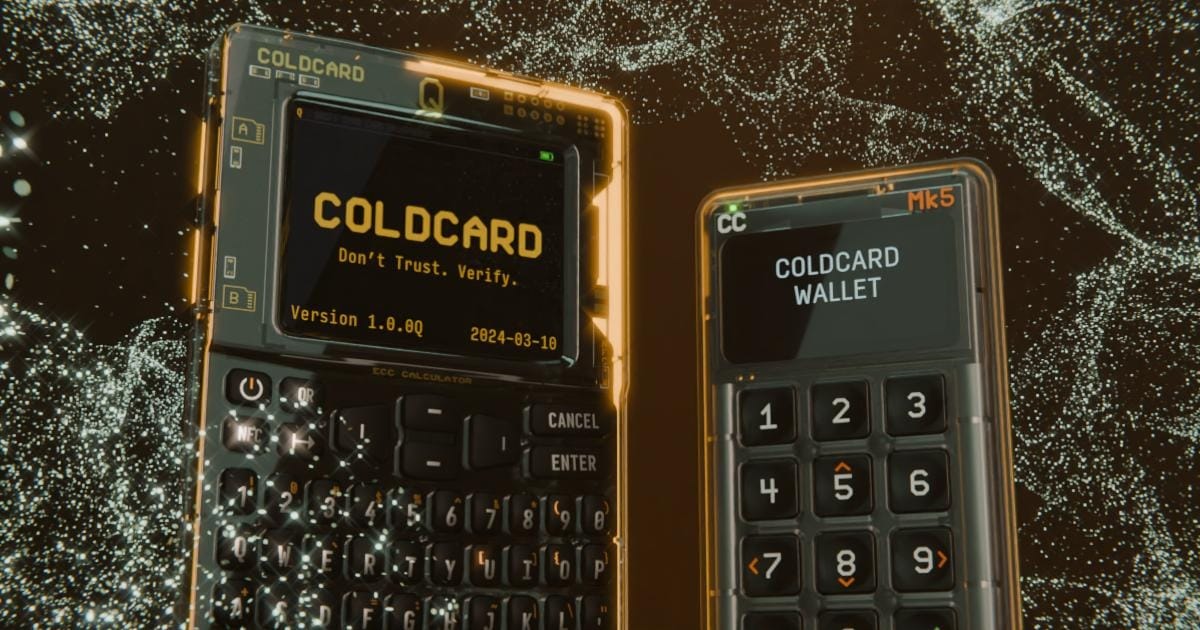
The Coldcard Q and Mk5 address this directly. Each ships in a serialized tamper-evident bag with a registered serial number to verify before opening. Both have clear cases for visual inspection of internal components on arrival. If you are holding a meaningful amount of Bitcoin, knowing the device you received is the device that was built is not a minor detail. Jade Plus ships in standard retail packaging with no equivalent verification features.

What Blockstream Jade does well

Blockstream is an established Bitcoin company with a strong technical reputation, and the Jade Plus has genuine strengths worth mentioning.

  • Fully open-source firmware. Jade's firmware is open-source and auditable. Blockstream also publishes the oracle implementation, so the full security model can be independently reviewed.
  • QR-based air-gapped signing. Jade Plus supports fully air-gapped transaction signing via QR codes or microSD cards, with no USB data connection required.
  • Taproot and Miniscript support. Jade Plus supports Taproot (P2TR) transactions and Miniscript spending policies, covering the Bitcoin protocol features most users need today.
  • BIP-85 child seed derivation. Jade supports BIP-85, allowing multiple independent child seeds to be derived from a single master.
  • Anti-Exfil (Anti-Klepto) protection. Jade implements Anti-Exfil, preventing a compromised host machine from leaking the private key through signature manipulation.
  • Competitive price point. Jade Plus is priced lower than Coldcard Q and Mk5, making it an accessible entry point for users who want open-source QR air-gap capability.
  • Battery-powered operation. Jade Plus includes a built-in battery. For users who prefer a device that stays charged between uses rather than requiring a power source, this is a practical advantage.
  • Self-hostable oracle. Users who do not wish to rely on Blockstream's servers can run their own blind oracle instance, and the oracle code is open source.

Which signing device is right for you?

Both are open-source air-gapped signing devices. The choice is about hardware security model and feature depth.

Choose Coldcard

  • You want hardware-level key protection with a dedicated secure element chip
  • You want a Bitcoin-only device with no Liquid or multi-protocol scope
  • A self-destruct PIN and duress wallet PIN are part of your threat model
  • Supply chain transparency matters: serialized packaging and viewable internal electronics
  • You want advanced seed management options: Seed XOR, Seed Vault, user-contributed entropy
  • You are building or managing a multisig vault with complex key requirements
Shop Coldcard

Choose Blockstream Jade Plus

  • You want open-source QR air-gapped signing at a lower price point
  • You are comfortable with the oracle model, or plan to use SeedQR mode to eliminate the oracle dependency
  • You use Liquid or operate within the Blockstream ecosystem
  • You want battery-powered, cable-free operation with a built-in camera for QR scanning
  • Taproot, Miniscript, and BIP-85 cover your protocol requirements
Visit Blockstream Jade